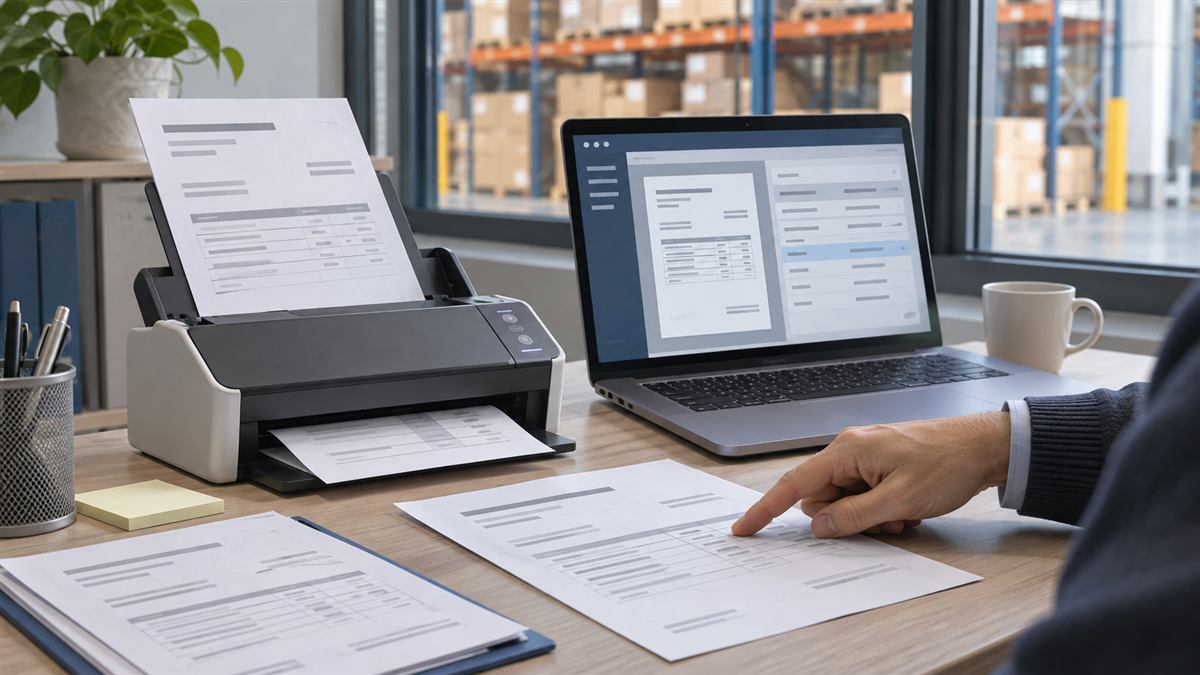
The management of a warehouse can prove to be a much more complicated activity than one might imagine, especially if we are talking about a company that has numerous stocks and has to cope with continuous loading and unloading of goods. An error in this area can prove to be very dangerous since when we talk about goods we are obviously dealing with a topic closely related to money: not having precise control over what is in storage can be the cause of significant economic damage. Precisely for this reason, companies increasingly resort to using warehouse management software, to automate all processes. How to choose the most suitable one? Here are some useful tips.
The warehouse has always been one of the most critical elements for a production company. In fact, inside what sometimes becomes a real black hole, you run the risk of losing raw materials and finished products, without having a precise idea of how much is actually available and what you might need to buy, often putting yourself in critical situations with your customers. To take into account what is contained in the warehouse, therefore, an inventory has always been carried out on a periodic basis, but even this system does not prove infallible because it is often subject to human error. Precisely for all these reasons, companies of a certain size, but increasingly also SMEs, decide to use some management software which allows them to automate many processes in order to have greater control not only over the warehouse but also and above all over the loading and unloading of goods and the quantitiesof inventory in real time.
Given the importance of effective control of the dynamics of the warehouse, it is natural that the management software used to automate processes must not only be of good quality but above all respect certain characteristics. In fact, today you can find many ERP, i.e. Enterprise Resource Planning, on the market, but not all of them have the same features and functionality, furthermore it is not necessarily the case that the chosen product must perform all 360 degree warehouse functions. Before purchasing management software, therefore, you need to carefully analyze what your needs are and then find the product that focuses precisely on those. In general, however, there are some aspects that cannot be missed and they are:
If these just described are the main features that a warehouse management software must necessarily have, there are others that can prove useful for a simpler and more correct organization of the warehouse and all its peculiarities. In fact, before choosing the product to use, one must always take into account that software must help the entrepreneur in carrying out his daily activities, therefore it must be able to automate some processes such as monitoring purchases through e-commerce and the possibility of creating the electronic invoice directly from the ERP, just to give a few examples. Furthermore, the software must be able to allow estimates regarding the returns of inventories and precisely in this respect it differs from simple inventory programs, which are nothing more than more advanced Excel files, which can manage a workload that is certainly less demanding than what warehouse management software can do.
As already underlined, companies can currently have numerous warehouse management software at their disposal, capable of meeting a vast range of needs that but they are quite generalized. The management programs, in fact, are designed to satisfy a broad audience, therefore they do not delve into specific needs that could only concern a small group of potential customers. Precisely for this reason, if the company that has decided to purchase warehouse management software needs a program that responds to certain characteristics, the ideal solution is to request the customization of the product or even the the creation of a software personalizedfor the individual case. In this sense, it is advisable to turn to companies specialized in the sector, such as TreDiPi, capable of listening carefully to the customer's requests and creating a project that effectively fills these gaps, in order to make warehouse management and more automated and more efficient.