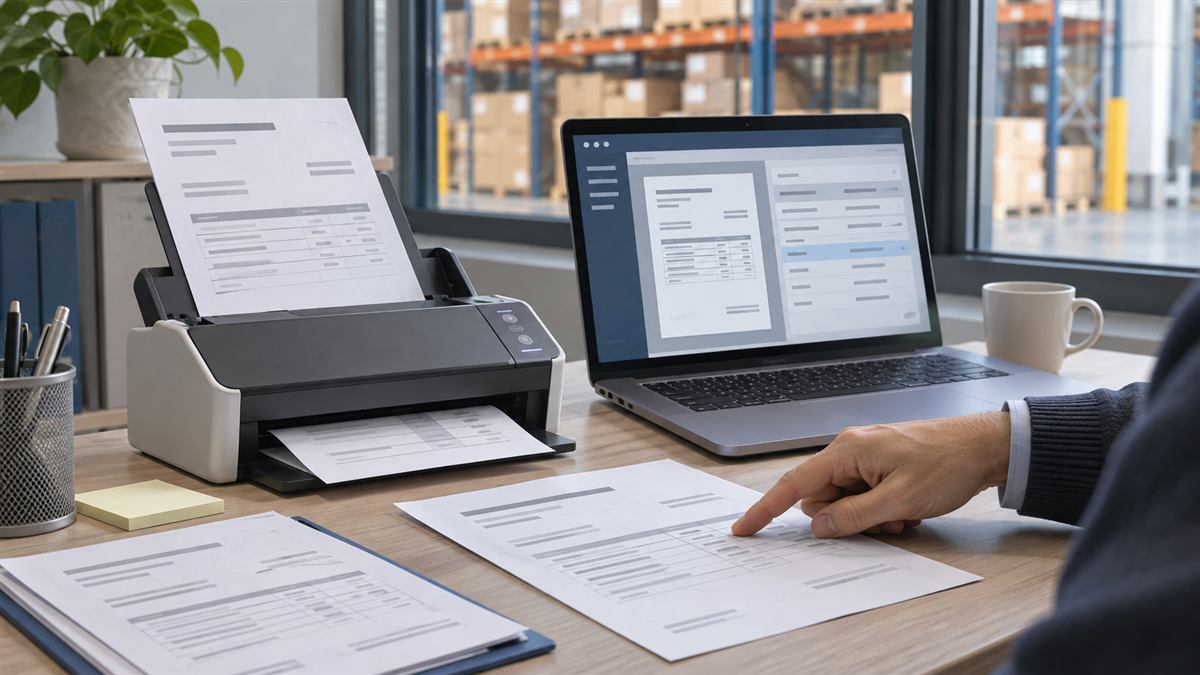
Orders and shipping documents arrive via email, in PDF or as scans. Reporting every reference, item code and quantity in the management system requires attention and repeats information that already exists in the document. Theautomation of data entry with AI can help prepare these steps, leaving people to review situations that require a decision.
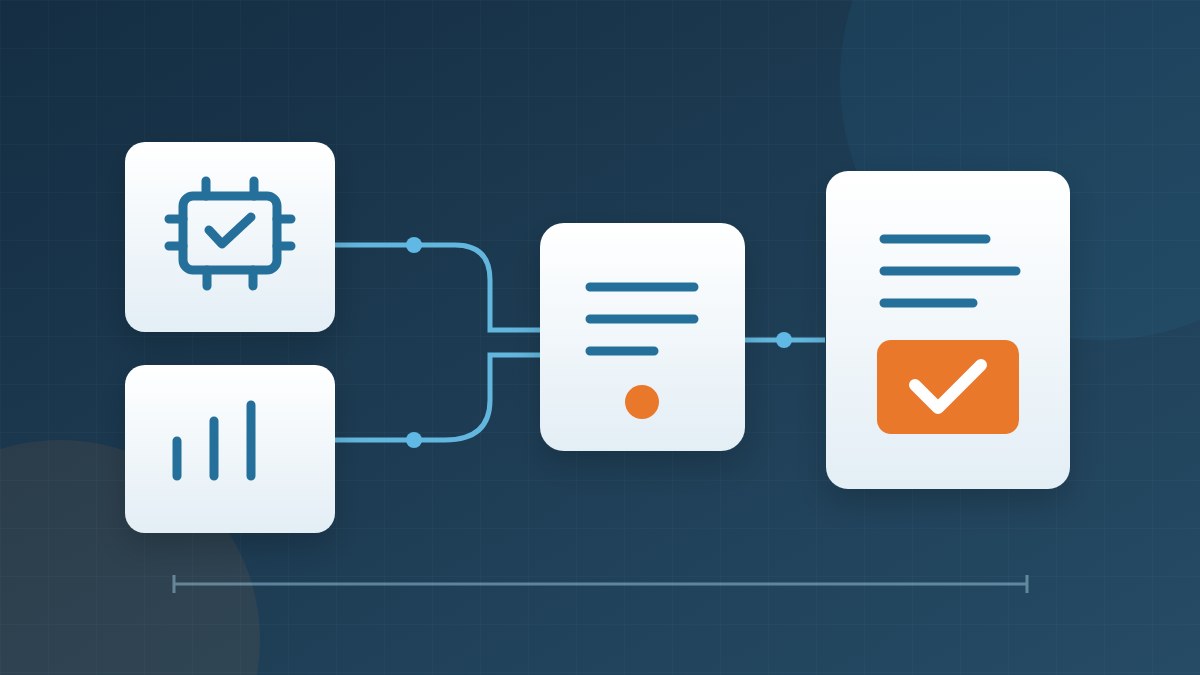
To build a useful flow, three elements must be connected: the original document, the company rules and the functions available in the management system. In this article we see how to tackle the process, what checks to foresee and how to evaluate a first test on orders and DDT.
Character recognition, often referred to as OCR, makes the text of a scan readable. Document processing then serves to identify structured information: document number, date, supplier references, product lines and quantities. These are distinct steps from recording an order or a warehouse movement.
Services like Azure Document Intelligence provide tools to extract text, tables and data from documents. To bring them into daily work you also need application controls, correspondence with personal data and a connection to the company software.
The first useful question is therefore: what operation do we want to prepare starting from this document? An order received can fuel a commercial draft; a purchase DDT can be compared with an existing order before proposing a registration. The behavior must be agreed with whoever manages the process.
A first list may include:
The code written by the supplier may be different from the internal one. You need to check if there is an approved match, how new items are handled, and who can confirm a match. Prices, conditions and availability must also come from the expected company sources, without being reconstructed by guesswork.
Defining these boundaries avoids asking AI to resolve ambiguities that belong to commercial or warehouse rules.
This sequence allows you to separate reading errors from registry or integration problems. If a stage breaks, the request must have a recognizable state and a path to be resumed or handled manually.
Let's consider a hypothetical example: a distributor receives a PDF DDT and must compare it with a purchase order. This is not a customer result or a feature already available in a TreDiPi product.
The document shows a supplier code and a quantity expressed in packs, while the management system uses an internal code and records the pieces. A first integration can search for correspondence in the authorized registry and check whether an approved conversion rule exists.
If the match is missing, the row is submitted for review. If the quantity does not coincide with the expected one, the operator sees the deviation together with the original document. After confirmation, the system prepares the operation agreed in the management system and records the outcome.
The value of the test lies in making comparison easier and in focusing attention on exceptions. The decision to accept a difference or change a personal data remains entrusted to those responsible for it.
A readable number can still be attributed to the wrong field; a similar description may refer to different products. Checks for required fields, formats, decimal separators, references, and line consistency are useful.
Some tools return confidence scores for the extracted data. As the Microsoft documentation on accuracy and confidence, these scores must be interpreted and evaluated on your use case documents. A high value does not replace company controls.
The revision thresholds must reflect the consequences of the error: an ancillary description and a quantity intended for a warehouse movement have different impacts. For a missing field it is preferable to show incomplete information rather than invent its value.
Before choosing the AI component, it is best to check the API, import procedures or other documented connections of the management system. An available interface does not mean that it allows all desired operations: permissions, validations, document states and error management must be checked.
The integration should be able to distinguish a successful registration from a failed response. An operation key, defined for the process and verified by the system, helps to recover the outcome without creating a second order or movement with each attempt.
You also need to establish who maintains code matches and how document reviews are handled. It's a job integration between systems which includes rules, interfaces and operational responsibilities.
The test must be prepared with authorized data and a defined perimeter. It is established which documents to acquire, which information to send to the extraction service, where to keep it and for how long, according to the rules applicable to the specific case.
The application must use credentials with the permissions necessary for the task, check attachments and treat the contents of documents as data to be verified. An instruction present in a PDF must not be able to change the operations allowed by the system.
To follow a process you need references to the original, status, corrections and approval. Technical logs can describe errors and identifiers without indiscriminately copying entire documents or personal information. Protection and conservation choices require a dedicated evaluation, without automatically attributing conformity to a technology.
Starting from a document type, a flow and a limited group of suppliers makes it clearer what to check. The sample should also include difficult scans, missing lines, unknown codes, partial deliveries and repeated documents.
The convenience depends on the results of this comparison. It's not enough to measure how quickly a PDF is read if revising it requires more work. To prepare for the initial checks, the guide a may be useful evaluate an AI tool before real data.
We can start from the step that today requires the most copying: which documents arrive, where they are recorded and which information wastes time in verification. With the AI consultancy we can focus on the perimeter of a first test; with it custom software development we can evaluate the connections and controls on existing systems.
Do you receive orders or delivery notes and manually report them into the management system? For a initial discussion you can describe the flow and the software involved, without attaching confidential documents. Let's explore together where to start and we define which results to verify before extending the automation.