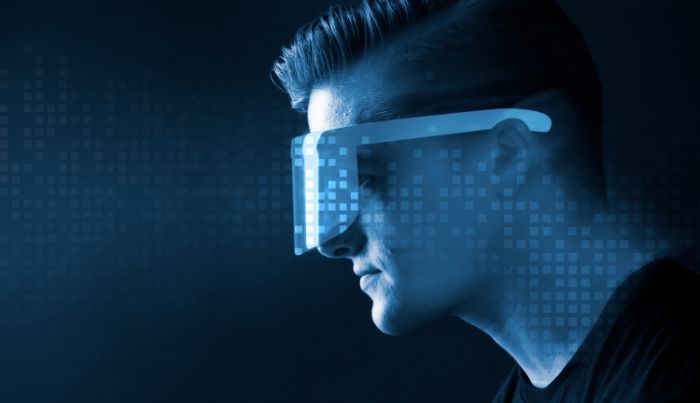
With the succession of technological evolutions, which occur in ever shorter timescales, we need to shift the development focus to complex systems that go beyond the creation of websites or mobile apps. In particular, augmented reality is gaining great importance, a flexible technology that is also user friendly due to the possibility of improving the surrounding reality and providing the user with real-time solutions and comments for the observer, increasing their knowledge, involvement and curiosity. We at Tredipì offer specific consultancy and use all the techniques necessary to support companies that want to start using AR (Augmented Reality) in the consumer market to enhance their online brand and take on the role of pioneering company in tech innovations.
With augmented reality, the user can observe the physical world that surrounds him in an integrated manner with digital visual elements that help him experience sensorial stimuli, auditory in particular, provided through technological aid. In this sense, augmented reality is governed by a series of algorithms that calculate in real time the measurements and noises of everything that surrounds the observer, visualizing them through an aid which can be the screen of a smartphone or the possession of a dedicated headset. The algorithm is, essentially, a tool capable of calculating distances and perceiving the space and time of what is displayed, restoring fidelity in proportions and three-dimensionality. In essence, augmented reality is nothing more than the user's everyday life fused with digital elements that coexist naturally with the environment and provide new information, coexisting with the observed space for various purposes, one of many being to allow greater immersion of the user and his feeling of control.
To benefit from augmented reality, the user must have an output device at his disposal which, based on current knowledge, can be of two types: the first and most widespread it is certainly mobile, via smartphones and tablets, i.e. viewers dedicated to the so-called mixed reality. The use of one tool rather than another is very important from the point of view of the final experience for the user, both in terms of design in development and actual use, as well as the benefits obtained by the user. As regards augmented reality for mobile devices, in fact, the main objective is to allow the user to have fun: it therefore has a purely recreational scope of use. The mixed augmented reality permitted by the headsets, however, has a much more complex and probably interesting scope of application: so its use requires hardware that is sometimes very expensive, and has interesting applications even in the medical and work environment, especially if integrated with cloud management systems.
The areas of application of augmented reality are truly very large and this is why we at Tredipi invest many resources and specific consultancy for all interested parties. Starting from augmented reality in industry 4.0, a fertile environment especially with regards to the possibilities of augmented reality for remote assistance or maintenance of IT systems, we move on to augmented reality for marketing and logistics: for the latter, a possible application is to allow resources to immediately access information about the availability of objects for sale, while for marketing the implications ofreality augments are exceptional: just think, for example, of the virtual try on (VTO) applications, which allow the user to virtualize the desired product, try it out and share the sensations, effectively increasing advertising.
Finally, augmented reality in the medical field is becoming increasingly important, with some so far experimental applications of pre-operative planning or even intraoperative, with contextual and real information about the patient's status.
In some cases, the dividing line between virtual reality and augmented reality can become confusing: although they may seem the same thing, the principles and methods of application behind the two technologies are very clear. In fact, while augmented reality allows you to interact with the real world using computer systems, therefore using algorithms to analyze and obtain information directly from what really surrounds the observer - the so-called physical world - virtual reality is a more or less artificial simulation, generated by a computer, of situations or places that may not even be real. For this reason, although there are applications of virtual reality also for production and training purposes, such as the preparation of personnel assigned to dangerous jobs, the substantial tendency of virtual reality to lend itself only to recreational and recreational use, without any other claims, remains.